How Does a Suppressor Actually Work?
Posted on: October 22, 2026
Table of Contents
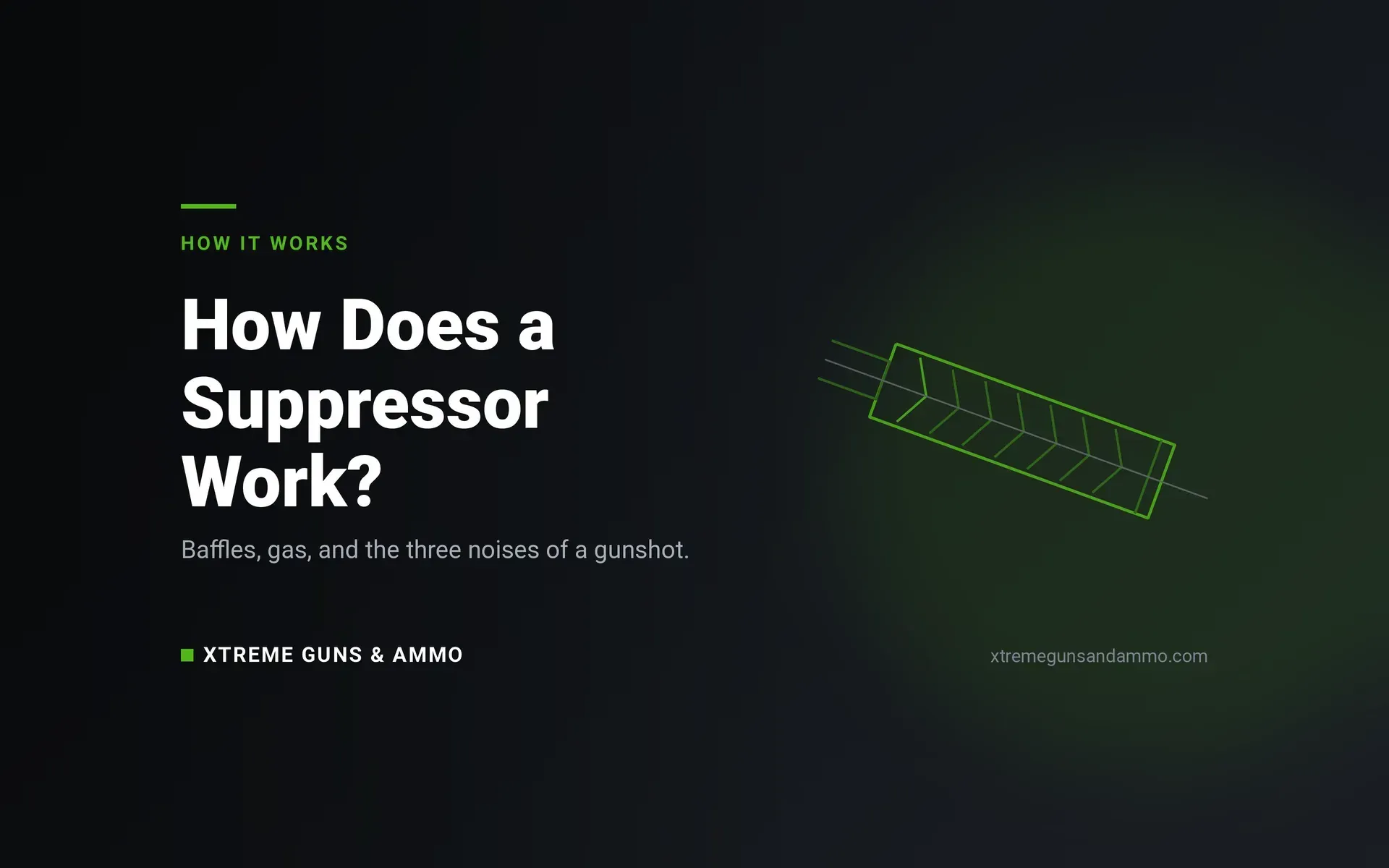
A suppressor is a sealed metal tube containing a series of baffles that bolts to the muzzle of a firearm. When the gun fires, the propellant gas following the bullet enters that tube instead of escaping straight into the atmosphere. The baffles force the gas to expand, slow and cool inside a much larger volume before it exits. Reducing the speed and pressure of that gas release is what reduces the muzzle blast, which is the loudest part of a gunshot. A typical centerfire suppressor removes 20 to 35 decibels.
Key takeaways
- A gunshot makes three separate noises. A suppressor only addresses one of them.
- Typical noise reduction is 20 to 35 decibels, which is meaningful but nothing like the silence shown in films.
- Most unsuppressed gunshots measure between 140 and 165 decibels. Hearing damage risk generally begins around 140 decibels.
- Only subsonic ammunition removes the sonic crack, because that noise comes from the bullet, not the gun.
- Suppressors also reduce felt recoil and muzzle flash, which are often more noticeable benefits than the sound reduction.
- The trade-offs are added weight and length, heat, increased back pressure and a shift in point of impact.
- "Silencer" and "suppressor" describe the same device. Silencer is the older legal term, suppressor is the more accurate one.
Why is a gunshot loud in the first place?
Three separate things make noise when a rifle fires. Knowing which is which explains everything a suppressor can and cannot do for you, so it's worth thirty seconds of your time.
Muzzle blast is the big one. Burning propellant produces a large volume of gas at extremely high pressure, on the order of tens of thousands of pounds per square inch. When the bullet leaves the barrel, that gas follows it and expands violently into air at normal atmospheric pressure. The result is a pressure wave, and that wave is the bang you hear.
The sonic crack comes from the bullet itself. Any projectile traveling faster than the speed of sound, roughly 1,125 feet per second at sea level, drags a shock wave behind it for the entire flight. It sounds like a sharp whip crack, and it originates along the bullet's path rather than at the shooter.
Mechanical noise is the action working. The bolt unlocking, cycling, stripping a fresh round and locking up again. On a semi-automatic that's a distinct clatter.
A suppressor works on the first of those three. It can't touch the second unless you're shooting subsonic ammunition, and it can't touch the third at all. If you've ever wondered why suppressed rifles in films sound nothing like the ones at your range, that's the whole answer.
What is happening inside the tube?
The suppressor gives the propellant gas somewhere to go that isn't the open air.
Think of it as a controlled expansion chamber. The gas leaves the muzzle at very high pressure and enters a sealed volume many times larger than the bore. Expanding into that space drops its pressure. The baffles inside then interrupt the gas flow, forcing it to change direction repeatedly, creating turbulence and swirl rather than a straight jet.
Two things happen as a result. The gas spends longer inside the tube, which gives it time to cool, and cooler gas occupies less volume and carries less energy. By the time it finally exits past the end cap, its pressure has dropped dramatically. A slower, cooler, lower pressure gas release produces a much smaller pressure wave, and a smaller pressure wave is a quieter sound.
None of that sound energy is destroyed. It's converted into heat inside the suppressor, which is why a can gets extremely hot very quickly. After a magazine of rapid fire, a suppressor can reach temperatures that will burn skin instantly and produce visible heat mirage over your sight picture. Worth remembering the first time you reach for one on the bench.
What are the parts of a suppressor?
If you're shopping for your first can, these are the five components a spec sheet will talk about.
The mount attaches the suppressor to the firearm. Direct thread mounts screw straight onto a threaded muzzle and are simple, light and secure. Quick detach systems use a muzzle device as an interface, letting one suppressor move between several hosts in seconds, at the cost of a little weight and a little repeatability.
The blast baffle is the first baffle the gas hits, and it takes far more abuse than any other component. It sees the highest pressure, the highest temperature and any erosion from the gas jet. Manufacturers typically build this component from the most durable material in the design.
The baffle stack is the series of baffles behind it. Traditional designs use individual cone-shaped or K-shaped baffles stacked in the tube. Monocore designs machine the whole stack from a single piece of metal, which simplifies assembly and cleaning. Additive manufactured suppressors are printed as one continuous geometry, which allows internal shapes that could not be machined at all.
The tube contains everything and provides the expansion volume.
The end cap closes the front, sets the final bore aperture and provides the last restriction before the gas leaves.
Materials matter more than they look, and this is where price differences usually come from. Aluminum is light and cheap but limited to rimfire and pistol pressures. Stainless steel, typically 17-4, is durable and affordable and common in rifle cans. Titanium offers an excellent strength to weight ratio and dominates the lightweight rifle market. Inconel and similar superalloys are the traditional answer for sustained full-automatic fire and magnum pressures, though modern titanium designs increasingly carry the same ratings. The comparison further down shows how little separates them on paper.
How much quieter is it, really?
Considerably quieter, and nowhere near silent.
Most unsuppressed centerfire rifles measure somewhere between 155 and 165 decibels at the shooter's ear. Handguns generally run 155 to 165 as well. A good suppressor typically removes 20 to 35 decibels from that figure.
The decibel scale is logarithmic, so those numbers understate what you actually hear. Every 10 decibel reduction is perceived as roughly halving the loudness. A 30 decibel reduction therefore sounds dramatically different in person, not marginally so.
What it won't do is bring most rifles below the threshold where hearing protection stops being sensible. Hearing damage risk generally begins around 140 decibels for impulse noise, and a suppressed centerfire rifle firing supersonic ammunition often still sits at or above that. Keep your plugs in. The suppressed .22 rimfire and the suppressed subsonic pistol are the genuine exceptions, and they're the source of most of the "movie quiet" footage online.
One more thing worth knowing before you compare spec sheets. Manufacturer decibel ratings deserve skepticism. Test conditions, microphone placement, barrel length, ammunition and even weather all move the number, and there's no universally enforced testing standard across the industry. Treat published figures as a rough comparison between products from the same maker, not as an absolute.
Two cans, one difference

Here is a comparison worth sitting with, because it isolates the material question better than any explanation can. Both of these are on our shelf.
Ambient Arms builds the EXO 7.62 in two versions. Same 7.9 inch length. Same 1.75 inch diameter. Both rated to .300 Win Mag, both claiming around 35 dB of reduction, both full-auto rated with no barrel length restriction, both on the same 2,500 round cleaning interval, both the same price.
The titanium version weighs 11.9 ounces. The Inconel version weighs 21 ounces.
Nine ounces, and on paper nothing else at all. What the spec sheets don't tell you is why you would choose the heavier one, and that's the question worth putting to whoever is selling it to you rather than working out from a chart. Material choice is where suppressor design gets genuinely arguable, and any shop that can't give you a straight answer on it is a shop to be careful with.
That 35 dB figure is also a useful sanity check on the range quoted earlier. It sits at the top of the 20 to 35 band, it's a manufacturer's own number, and it's measured under conditions the manufacturer chose.
What about the benefits nobody advertises?
Sound reduction gets the attention. Two other effects are often more noticeable in practice, and they're the ones most owners end up talking about.
Recoil reduction is substantial. A suppressor adds mass at the muzzle and slows the release of propellant gas, and both reduce the impulse you feel in your shoulder. Many shooters report that a suppressed rifle feels like it dropped a full step in cartridge size. On a magnum rifle, that difference can be the reason someone shoots it well.
Flash reduction is close to total on most designs. The propellant gas that would ordinarily ignite in front of the muzzle burns inside the tube instead. In low light, that's the difference between keeping your night vision and losing it with every shot.
Reduced blast to the sides matters more than people expect on a firing line or in a hunting party. If you shoot next to family, the person standing beside you gets a far gentler experience.
What are the downsides?
Nobody selling suppressors leads with this list, so here it is plainly.
Weight and length. A rifle suppressor adds roughly 6 to 9 inches and anywhere from 8 to 25 ounces at the worst possible place for balance, right at the muzzle.
Heat. Sustained fire makes a suppressor hot enough to cause serious burns, and the heat mirage rising off it will degrade your sight picture through a scope.
Back pressure. This is the one that surprises people. A suppressor raises pressure in the system, and on a direct impingement AR that means more gas driving the bolt carrier and more gas venting back toward your face. Expect faster fouling, a dirtier action and, on some rifles, genuinely unpleasant gas to the eyes. Adjustable gas blocks and low back pressure suppressor designs exist specifically to address this.
Point of impact shift. Adding a suppressor changes barrel harmonics and almost always moves the point of impact. The shift is usually consistent and repeatable for a given can and host, but you'll need to confirm a separate zero for suppressed shooting.
First round pop. The first shot through a cold suppressor is often noticeably louder than those following it, because oxygen inside the tube ignites on that first shot and doesn't fully replenish between subsequent rounds.
None of these are reasons not to buy one. They're just the things worth knowing before you do.
Do suppressors need cleaning, and how long do they last?
It depends entirely on what you're shooting through it, and the answer splits cleanly in two.
Rimfire suppressors need regular cleaning. Unjacketed lead .22 ammunition deposits lead and carbon fouling heavily, and left long enough that fouling will seize the components solid. Rimfire cans are therefore almost always built to be disassembled, and cleaning them is routine maintenance.
Centerfire rifle suppressors are effectively self-cleaning, and most should never be taken apart. The temperatures and pressures involved burn off most fouling in normal use. Many are sealed welded units that cannot be disassembled at all, and attempting to open a sealed can will destroy it. Check the manufacturer's guidance before you touch anything.
Service life on a quality centerfire suppressor used within its rating is long. Under normal semi-automatic use, a well made can will typically outlast several barrels. Suppressors are worn out by heat and erosion rather than round count, so sustained full-automatic fire or heavy magnum use shortens life dramatically, while occasional hunting and range use barely touches it.
The realistic failure modes are baffle erosion from sustained high volume fire, and a baffle strike caused by a misaligned mount or a loose thread. Baffle strikes are almost always a mounting problem rather than a suppressor problem, which is a good argument for having the mount fitted and checked properly rather than doing it yourself the night before a hunt.
If you're considering a suppressor, confirm the host firearm has a correctly threaded and concentric muzzle first, because alignment is what keeps the bullet passing cleanly through the bore of the can. Any competent shop will check that for you.
Frequently Asked Questions
What's the difference between a silencer and a suppressor?
They are the same device. "Silencer" is the original and the legal term, dating to Hiram Percy Maxim's Maxim Silencer patent in 1909, and it is the word used in US federal law. "Suppressor" became the industry's preferred term because it describes what the device actually does, which is suppress sound rather than eliminate it. Neither word indicates any difference in design or function, so you can use either one.
What is the downside of a silencer?
The main trade-offs are added length and muzzle weight, significant heat build-up during sustained fire, increased back pressure that sends more gas toward the shooter on semi-automatic rifles, and a shift in point of impact that means confirming a separate zero. There is also a first round pop, where the first shot through a cold suppressor is louder than those that follow. None of these are dealbreakers, but you should know about them before buying.
How many rounds will a suppressor last?
A quality centerfire suppressor used within its rating will typically outlast several barrels under normal semi-automatic use. Suppressors wear out through heat and erosion rather than round count, so sustained full-automatic fire and heavy magnum use shorten service life considerably, while occasional range and hunting use has very little effect. For most owners, that means the can outlives the rifle it was bought for.
Do suppressors make a gun completely silent?
No. A suppressor typically reduces the report by 20 to 35 decibels, which is a large and immediately obvious difference but far from silence. It only reduces muzzle blast, so a supersonic bullet still produces a sonic crack and the action still makes mechanical noise. Only subsonic ammunition in a low noise firearm approaches the quiet you see in films, so keep your hearing protection on.
Do I still have to pay $200 for a suppressor?
No. Congress cut the federal tax on suppressors from $200 to $0 starting January 1, 2026. On October 9, 2026, following a federal court ruling in Texas, the ATF also announced it would stop requiring Form 4 approval and registration for suppressors. That is an enforcement policy, not a change in the law, and the ATF itself says Congress, the courts or the Department of Justice could reverse it, so the registration side is still not settled. A licensed dealer still runs a background check before transferring one to you, and state laws have not changed: some states ban suppressors outright, and the ATF says it cannot tell you how your state treats an unregistered one. Before you buy, check the current federal position with the ATF and the rules in your own state. This is general information, not legal advice.
Do I need to clean my suppressor?
Rimfire suppressors need regular cleaning, because unjacketed lead ammunition fouls them heavily and can eventually seize the components together. Centerfire rifle suppressors are largely self-cleaning under normal use, and many are sealed units that must never be disassembled. Always check the manufacturer's guidance before attempting to open any suppressor.