1911 vs 2011: What’s the Actual Difference?
Posted on: July 08, 2026
Table of Contents
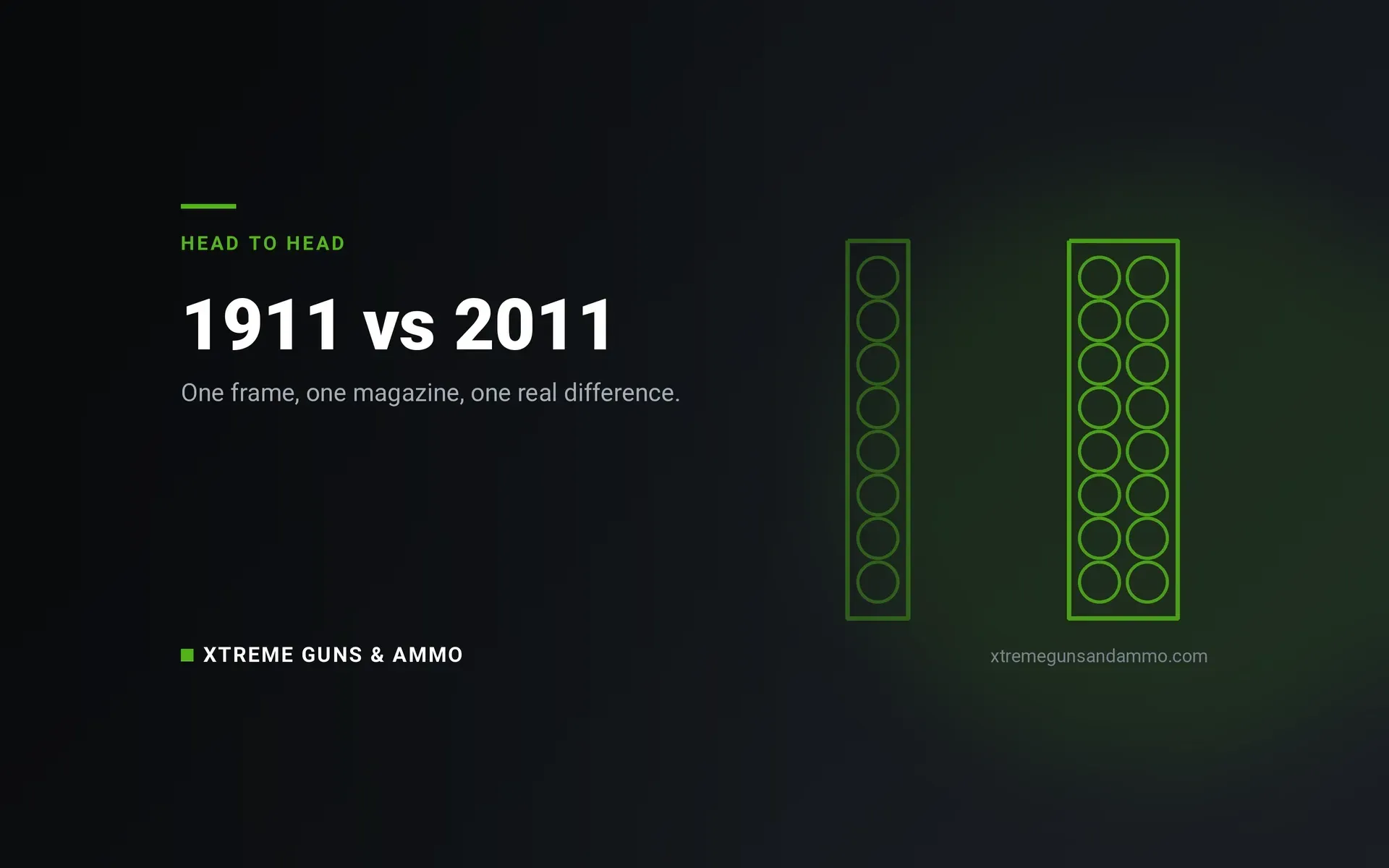
The core difference between a 1911 and a 2011 is the frame and the magazine. A 1911 uses a one-piece metal frame with a single-stack magazine, typically holding 7–10 rounds. A 2011 uses a two-piece frame — a metal fire-control unit joined to a polymer grip module — that houses a double-stack magazine holding around 17–20+ rounds in 9mm. Both share the same 1911-style single-action trigger and manual thumb safety, so a 2011 feels familiar to shoot but delivers roughly double the capacity. 2011s are generally more expensive because of their more complex, precision-fit construction.
Below, we break down every meaningful difference so you can decide which platform fits your needs.
1911 vs 2011: the short answer
Think of the 2011 as the high-capacity descendant of the 1911. John Browning’s 1911 defined the single-action, semi-automatic pistol for over a century. The 2011 keeps that trigger and manual of arms but replaces the slim, single-stack frame with a modular, double-stack design. If you love how a 1911 shoots but wish it held more rounds, the 2011 was built for you — at a higher price.
Frame design: one-piece vs modular two-piece
This is the heart of the difference. A 1911 has a single machined frame — usually steel or aluminum — that forms the grip, houses the magazine, and carries the fire-control parts. A 2011 splits that job in two: a machined metal section handles the slide rails and fire-control geometry, and a separate polymer grip module bolts on below to form the grip and hold the magazine.
That modularity is the whole point. The two-piece design makes physical room for a wider magazine and lets grip modules be swapped or sized to the shooter — but it also demands precise fitting, which is why quality 2011s cost more to build.

Magazine capacity: single-stack vs double-stack
A standard 1911 magazine stacks rounds in a single column, giving typical capacities of 8–10 in 9mm or 7–8 in .45 ACP. A 2011 uses a double-stack (staggered) magazine, pushing 9mm capacity into the high teens and low twenties depending on the model and magazine length. For competition and duty use, that capacity difference is the single biggest reason shooters move to the 2011.
Important compatibility note: the two are not magazine-compatible. A 2011 uses wide double-stack magazines built for the platform; single-stack 1911 magazines will not work in a 2011.
Trigger, ergonomics, and shooting feel
Here the two are close cousins. Both use a single-action trigger — the hammer is cocked and the trigger simply releases it — producing the short, crisp press that 1911/2011 shooters love. Both typically have a manual thumb safety and a grip safety, so the manual of arms transfers directly between them.
The differences you’ll feel: a 2011’s grip is slightly wider (to hold the double-stack magazine), and many shooters find the extra width and weight actually help manage recoil. The 1911 grip is slimmer and, for some hands, more natural to conceal.
Price: why 2011s cost more
Expect to pay meaningfully more for a 2011. Solid 1911s are available across a wide price range, while quality 2011s commonly start around $2,000 and climb well beyond that. The premium comes from the two-piece frame, the precision required to make a double-stack 1911 feed reliably, match-grade components, and skilled hand-assembly. We cover this in depth in why Staccato pistols are so expensive.
Reliability and maintenance
A quality 1911 is a proven, reliable design with over a century of refinement. A quality 2011 is also highly reliable — reliable enough for law-enforcement duty use — but it is a more complex machine feeding from a double-stack magazine, so it is more sensitive to build quality, magazine quality, and lubrication. With a reputable maker and proper care, both platforms run well; the 2011 simply rewards buying quality more than the simpler 1911 does.
Full comparison table
Feature
1911
2011
Frame
One-piece steel/aluminum
Two-piece: metal frame + polymer grip module
Magazine
Single-stack
Double-stack
9mm capacity
8–10 rounds
17–20+ rounds
Trigger
Single-action
Single-action
Safeties
Thumb + grip safety
Thumb + grip safety
Typical price
Lower, wide range
Higher (commonly $2,000+)
Best for
Heritage, slim carry, range
Competition, duty, high-capacity carry
Leading makers
Colt, Springfield, Kimber, and many others
Staccato (formerly STI), and others
Which should you buy?
• Choose a 1911 if you want a slimmer, lighter, often more affordable pistol, value the heritage, or carry deep concealment.
• Choose a 2011 if you want maximum capacity with a premium single-action trigger — the top choice for USPSA/IDPA competition, duty carry, and enthusiasts who want the best-shooting pistol they can buy.
Not sure where to start on the 2011 side? Our what is a 2011 pistol guide covers the platform, and you can compare current Staccato models on our Staccato 2011 page.
Frequently Asked Questions
Is a 2011 better than a 1911?
Not universally. A 2011 offers far more capacity and a modular grip, while a 1911 is slimmer, often less expensive, and carries deep heritage. The best choice depends on your use case.
Can a 2011 use 1911 magazines?
No. 2011s use wider double-stack magazines designed for the platform; standard single-stack 1911 magazines are not compatible.
Why are 2011s so much more expensive than 1911s?
The two-piece frame, double-stack fitting, and precision hand-assembly required for reliability add significant cost.
Do 1911 and 2011 shoot the same?
They share the same single-action trigger system and manual thumb safety, so the manual of arms and trigger feel are very similar; the 2011 grip is slightly wider.