
Piston vs Direct Impingement AR-15: Which Is Better?
Posted on: November 05, 2026
Table of Contents
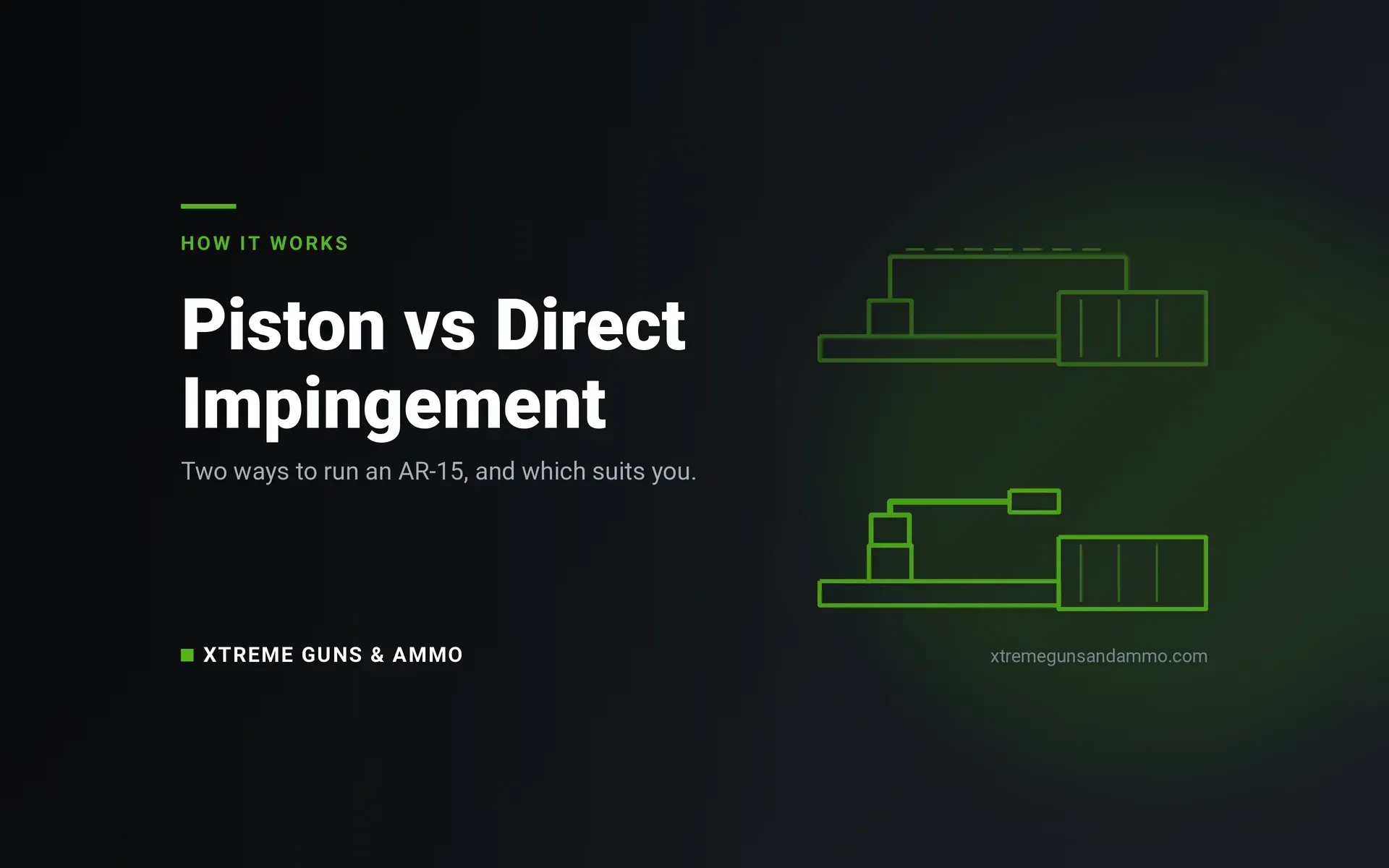
Piston vs direct impingement comes down to where the gas goes. In a direct impingement AR-15, gas from the fired cartridge travels back through a tube into the bolt carrier and pushes it rearward to cycle the action. In a gas piston AR-15, that gas stays at the front of the rifle and drives a piston and operating rod, which push the carrier instead. Direct impingement is lighter, cheaper and uses standard parts. A piston keeps heat and carbon out of the receiver, which helps most when you shoot suppressed or fire a lot of rounds. Neither is better for everyone.
Key takeaways
- Direct impingement is the standard AR-15 system. The US military's M4 carbine uses it, and so do most AR-15s sold today.
- A short-stroke piston vents gas at the gas block, so far less heat and fouling reach the bolt carrier and chamber.
- Pistons add weight at the front. On one maker's comparable 16-inch rifles, the piston model weighs 7.3 pounds and the direct impingement model 6.5 pounds.
- At one manufacturer's list prices, a 16-inch piston carbine costs about 58 percent more than its direct impingement equivalent.
- Suppressors raise back pressure. On a direct impingement rifle, that sends more gas into the action and toward your face.
- Piston parts are proprietary. Direct impingement parts are standardized and interchangeable across most makers.
How does direct impingement work?
When you fire an AR-15, the bullet passes a small gas port drilled into the top of the barrel. Some of the propellant gas behind it escapes through that port into the gas block, then travels back through a thin gas tube that runs above the barrel into the upper receiver.
At the end of the tube, the gas enters the carrier key on top of the bolt carrier and flows into a chamber inside the carrier, behind the bolt. Strictly speaking, Eugene Stoner's design isn't pure direct impingement. The bolt and carrier act as a piston and cylinder, and the expanding gas pushes the carrier rearward off the bolt. As the carrier moves, a cam pin rotates the bolt to unlock it, the spent case is extracted and ejected, and the buffer spring drives everything forward to chamber the next round.
That design has very few moving parts at the front of the rifle. It's light, it keeps the mass close to the bore line, and it has been refined for more than sixty years. The trade-off is that hot, dirty gas is delivered straight into the heart of the action. Carbon builds up on the bolt tail, inside the carrier and around the chamber, and the bolt carrier group runs hot.
How does a gas piston work?
A gas piston AR-15 taps gas from the same kind of port in the barrel, but it stops it at the front of the rifle.
In a short-stroke system, which is what almost every piston AR-15 uses, the gas enters a small cylinder at the gas block and drives a piston rearward a short distance. The piston strikes an operating rod, and the rod strikes the bolt carrier and shoves it back to cycle the action. The gas itself vents out at the gas block rather than traveling into the receiver.
That's the key difference. A direct impingement rifle uses gas to move the carrier. A piston rifle uses gas to move a rod, and the rod moves the carrier. The heat and carbon stay up front, where they're easier to deal with and far away from your chamber and bolt.
It's worth knowing about long-stroke pistons too, even though you won't see them on many AR-15s. In a long-stroke system, the AK being the best-known example, the piston is attached to the bolt carrier and travels the full length of its stroke with it. Short-stroke designs are lighter and better suited to the AR's layout, which is why piston AR makers almost all use them.
What are the pros and cons of each?
Here's how the two systems compare in practice.
Direct impingement advantages
- Lighter, with less weight hanging off the front of the rifle
- Lower cost to buy and to maintain
- Standardized, interchangeable parts from dozens of makers
- A long track record and a huge base of armorer knowledge
- Often regarded as having a slight accuracy edge, since there's no operating rod striking the carrier
Direct impingement drawbacks
- Carbon and heat go straight into the bolt carrier group and receiver
- Needs more frequent cleaning and generous lubrication to run well
- Gets noticeably dirtier and gassier when suppressed
Gas piston advantages
- Cooler, cleaner action, since gas vents at the front
- Longer intervals between cleanings
- Better suited to heavy suppressor use, especially with an adjustable regulator
- Less fouling at the chamber, which helps in sustained fire
Gas piston drawbacks
- Heavier, with the extra weight at the muzzle end
- More expensive
- Proprietary parts, so you're tied to one maker for spares
- The operating rod strikes the top of the carrier off-center, which can cause carrier tilt and extra wear on the buffer tube unless the design accounts for it
Which is more reliable?
Both systems are reliable when they're well built, and build quality matters more than operating system for most shooters.
The US Army's M4 carbine is direct impingement, and it's been fielded in every environment imaginable. A good DI rifle that's kept lubricated will run through thousands of rounds without complaint. On the other side, the US Marine Corps' M27 Infantry Automatic Rifle is a short-stroke piston design based on the HK416, chosen partly for how it handles sustained fire.
Where a piston pulls ahead is under specific stress: long strings of rapid fire, heavy suppressor use, or long stretches between cleanings. Keeping heat and carbon out of the action pays off in those conditions. For range days, hunting and home defense, a quality direct impingement rifle is every bit as dependable.
Piston vs direct impingement with a suppressor
This is where the difference is easiest to feel.
A suppressor works by trapping propellant gas, and that raises the pressure inside the whole system. On a direct impingement rifle, more of that gas comes back down the gas tube into the carrier, and some of it vents out of the ejection port and the charging handle, right next to your face. You'll see faster fouling, a hotter bolt carrier group and, on some rifles, gas in your eyes. If you're new to suppressors, our guide on how a suppressor works explains why the back pressure happens.
A piston rifle vents that extra gas at the front, so the action stays far cleaner. Many piston rifles also include an adjustable gas regulator. On the LWRCI ICMKII, for example, a two-position paddle inside the rail lets you switch between suppressed and unsuppressed settings without tools.
You don't need a piston to shoot suppressed, and plenty of people run DI rifles with cans happily. Adjustable gas blocks and low back pressure suppressors exist precisely to fix the problem on a direct impingement rifle. A piston is simply the more complete answer if you shoot suppressed most of the time.
One maker, both systems

The cleanest way to see what the piston costs you is to look at a company that builds both. LWRCI sells its flagship ICMKII with a short-stroke piston and its IC DI line with direct impingement, and both are on our shelf.
Compare the 16-inch 5.56 ICMKII with the 16.1-inch IC-Discovery, the entry DI model:
- Operating system: short-stroke piston with a two-position gas regulator, against direct impingement
- Barrel: both spiral fluted, both 1:7 twist
- Weight: 7.3 pounds for the piston rifle, 6.5 pounds for the DI rifle
- Controls: fully ambidextrous on the ICMKII, standard right-handed fire controls on the IC-Discovery
- Sights: backup iron sights on the ICMKII, none on the IC-Discovery
That's a 0.8-pound difference, almost all of it in front of your support hand. The price gap between those two is wider than the piston alone, because the IC-Discovery also drops the ambidextrous controls and sights.
For a closer like-for-like comparison, look at LWRCI's own list prices for the 16-inch ICMKII and the 16-inch IC DI M-LOK, which share the barrel, the forged upper and the ambidextrous lower. The piston model costs about 58 percent more. That's roughly what the operating system itself costs you.
One more detail makes this pairing useful. LWRCI states that the IC DI lower works with the rest of its IC family, so you can buy the direct impingement rifle now and move to the piston system later by swapping only the upper. If you want to know more about the brand itself, our LWRC rifles guide covers it in detail.
Which should you choose?
Start with how you'll actually use the rifle.
Choose direct impingement if:
- It's your first AR-15, or you're building on a budget
- You want the lightest, best-balanced rifle for the money
- You value cheap, universal parts and easy upgrades
- Your shooting is mostly range days, hunting or home defense
Choose a gas piston if:
- You shoot suppressed most of the time
- You fire high volumes and want longer gaps between cleanings
- You want a duty-grade rifle and don't mind the extra weight and cost
Neither choice is a mistake. A well-made direct impingement rifle is the right answer for most shooters, and the money you save can go into optics, ammunition and training, which will do more for your shooting than any operating system. If you do go the piston route, you can browse piston-driven rifles alongside the rest of our AR-15 rifles to compare.
Frequently Asked Questions
Is a piston AR better than direct impingement?
Not for everyone. A piston AR runs cleaner and cooler and has an edge when you shoot suppressed or fire high volumes. Direct impingement is lighter, cheaper and uses standard parts, which makes it the better choice for most shooters.
Why do most AR-15s use direct impingement?
Direct impingement is Eugene Stoner's original AR-15 design, and it's what the military M4 uses. It's light, simple, inexpensive to build and supported by standardized parts from dozens of manufacturers, so it has become the default for the platform.
Do piston ARs run cleaner?
Yes. A piston system vents propellant gas at the gas block instead of sending it into the bolt carrier, so far less carbon and heat reach the action. The piston and gas block still need occasional cleaning, but the bolt and chamber stay much cleaner.
Is a piston AR better for suppressed shooting?
Generally, yes. A suppressor raises back pressure, and a direct impingement rifle sends that extra gas into the action and toward the shooter's face. A piston vents it at the front, and many piston rifles have an adjustable regulator with a suppressed setting.
Can you convert a direct impingement AR-15 to a piston?
Yes. Piston conversion kits and complete piston uppers exist for standard AR-15 lowers. A complete upper from a single maker is usually the more reliable route, because a kit has to work with parts it wasn't designed around.
Are piston AR-15s heavier?
Usually, yes, and the extra weight sits toward the muzzle. On one maker's comparable 16-inch rifles, the piston model weighs 7.3 pounds and the direct impingement model 6.5 pounds.